
Terminology guide
Court-Ordered, Mandated and Voluntary Treatment
The words people use around court-related care are not always precise. That can make a stressful situation even harder to sort out.
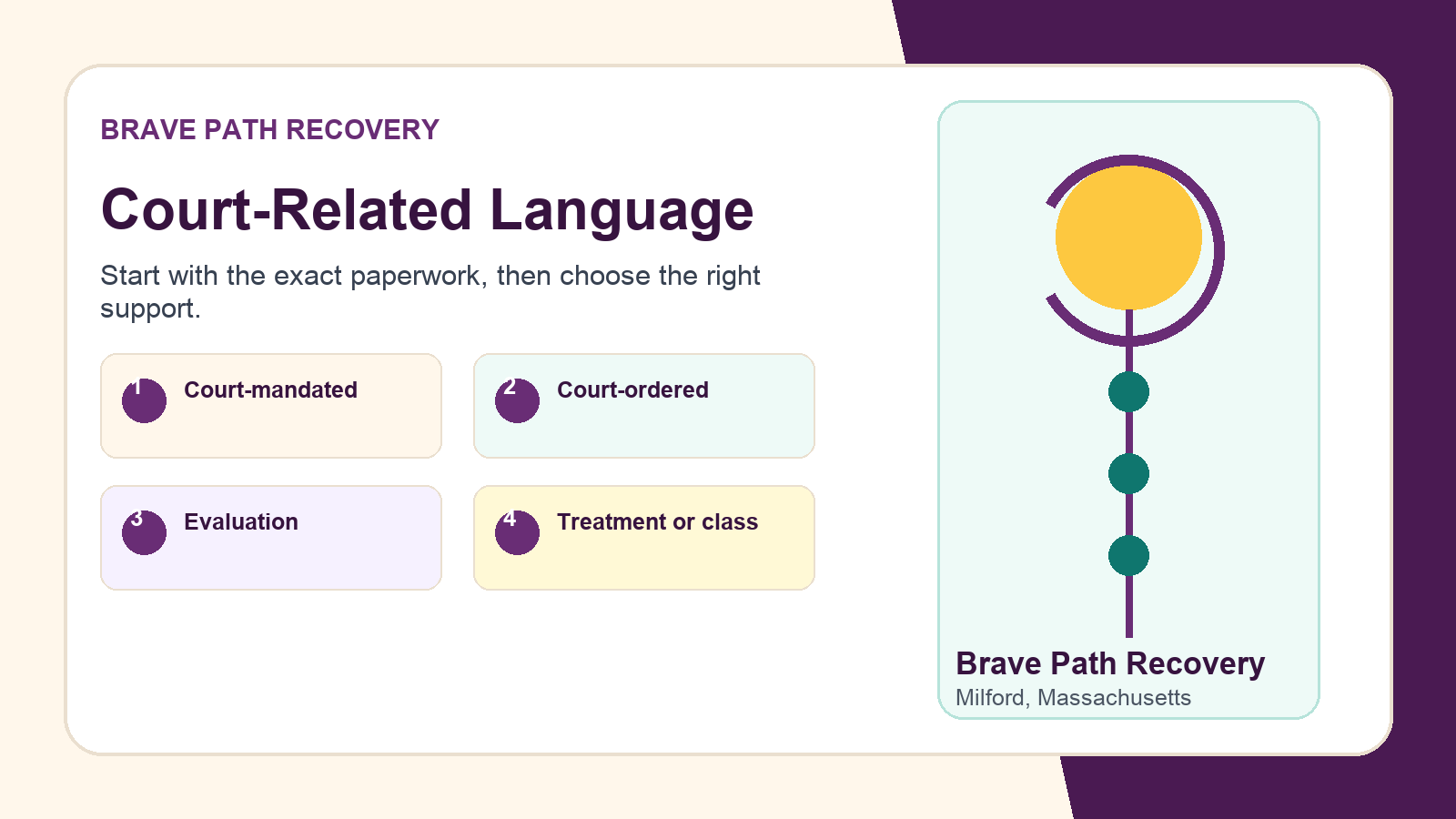
Short answer
In everyday conversation, court-mandated and court-ordered are often used to mean that a legal process is requiring or strongly directing someone to complete treatment, counseling, education, or an evaluation. The exact requirement is whatever appears in the court order, probation instructions, referral, or official program paperwork.
If the document mentions treatment for substance use, start with the court-related addiction treatment page. If it mentions therapy, use the therapy and counseling page. If it asks for an evaluation, use the evaluation guide.
Why the exact words matter
A person may say they need rehab when the document actually asks for an evaluation. Someone may say they need therapy when the referral is for a substance use treatment program. Another person may need a court-approved class rather than clinical treatment.
Before scheduling anything, read the paperwork line by line and ask who has authority to accept the service or documentation.
How Brave Path can fit into the conversation
Brave Path can help discuss outpatient mental health and substance use treatment options when that level of care is appropriate. Depending on the concern, that may include part-time day treatment, full-time day treatment, therapy, group support, or dual diagnosis care.
Brave Path cannot redefine a court order, provide legal advice, or promise that a particular service will be accepted by a court or probation office.
When a separate official program is needed
Some situations require an approved program, such as impaired driving education. If the paperwork mentions 24D, OUI, or driver alcohol education, review the 24D program guide and official state resources before assuming treatment alone is enough.
Common questions
Is court-mandated rehab different from court-ordered rehab?
Sometimes people use the phrases interchangeably. The exact meaning depends on the legal paperwork and the authority requesting care.
Should I use the phrase court-appointed treatment?
Only if that is the phrase in your paperwork. In most cases, the more useful question is what service is required and who must receive documentation.
Can treatment still be helpful if it is required?
Yes, it can be. Required attendance does not remove the need for respectful, useful care focused on safety, stability, and recovery.
What if the phrase is vague?
Ask the court, probation office, attorney, evaluator, or referral source to clarify the exact service and documentation required.
Helpful next resources
Court-related addiction treatment
For treatment and rehab language. court-related addiction treatment guide.
Therapy and counseling questions
For mental health or counseling language. court-ordered therapy and counseling guide.
Classes vs. treatment
For education and class requirements. court-ordered classes vs. treatment guide.
Talk through the next step
If outpatient care may fit, Brave Path can help you ask clearer questions about treatment options, schedule, scholarship opportunities, and what a first conversation can clarify. Start with the contact page or review Brave Path treatment programs.
Sources and safety resources
Voluntary care and court-related treatment requirements
Find out what is being requested
A voluntary treatment conversation begins with the person seeking care. When treatment is connected to a court or probation requirement, there may also be written conditions about an evaluation, provider, attendance, or documentation. Bring those questions to the official contact named in the paperwork before assuming a particular program meets the requirement. Learn about court-related treatment information at Brave Path Recovery.
Clinical fit still matters
A legal requirement does not establish which clinical services you need or whether a specific outpatient program is appropriate. Tell the provider about your concerns, previous treatment, and any deadlines. Ask what assessment is required and what services the program can actually provide.
Clarify documentation and consent
Ask the referring authority exactly what documentation is required and where it must go. Then ask the provider whether it can supply that documentation and which consent forms are needed. Keep dates and contact details organized. Ask for a secure way to share sensitive records rather than placing them in a general website message.
Do not leave unresolved questions until the deadline
If instructions are unclear, contact your attorney, probation officer, court, or other designated authority. Brave Path can discuss outpatient fit and its documentation process, but court acceptance and legal outcomes cannot be guaranteed. See classes versus treatment when the requirement names a specific service.