Updated · Published by Brave Path Recovery
Brave Path Recovery Resources
Section 35 questions can arise during difficult family situations. Start with the official Massachusetts process, keep legal questions with the court or counsel, and use this guide to organize care and follow-up questions.
What Section 35 means
Section 35 is a Massachusetts civil process through which a court may order involuntary treatment when the legal criteria are met. The Massachusetts guidance describes alcohol or substance use disorder and likelihood of serious harm as central to the decision. A clinician or outpatient program cannot decide what a judge will order.
The state says a commitment may last up to 90 days and may be shorter depending on clinical needs and the criteria for continued commitment. Consult the official process and criteria for legal details.
Common terms
| Term | Meaning and next question |
|---|---|
| Section 35 | A Massachusetts civil court process for involuntary commitment related to alcohol or substance use disorder and likelihood of serious harm. Ask the court or counsel about the legal criteria. |
| Petitioner | The eligible person who asks the court to consider a commitment. Ask the court whether you are eligible to petition. |
| Respondent | The person who is the subject of the petition. Questions about rights and representation belong with legal counsel or the court. |
| Civil commitment | A legal process that may require treatment when the legal criteria are met. It differs from voluntarily enrolling in an outpatient program. |
| Court-ordered treatment | A broader phrase for treatment connected to a court order. The written requirement determines what needs to be clarified. |
| Substance use evaluation | An assessment of substance use concerns. Ask the referring authority which evaluator and documentation it requires. |
Organize your questions before contacting the court
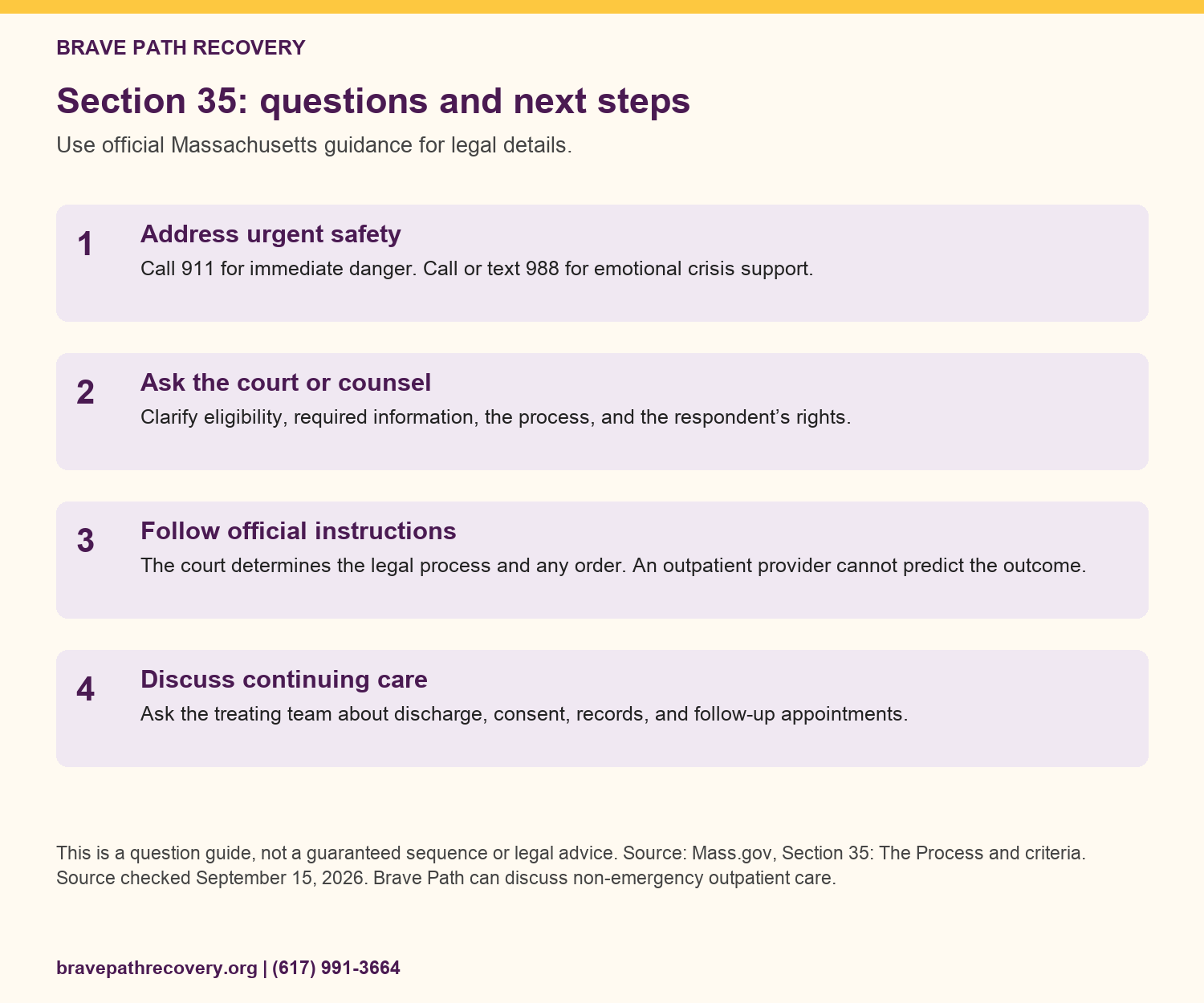
Ask the court or qualified legal counsel who may petition, what information is required, and what happens after a petition is filed. Keep the relevant court contact, dates, and questions together. Do not assume another family’s experience determines the process or outcome in your situation.
For a focused starting point, see questions about filing, commitment length, and record-related questions.
Discuss continuing care with the treating team
If treatment is ordered, ask the appropriate care team about discharge planning and recommended follow-up. When you are authorized to participate, clarify who arranges appointments, how records are shared with consent, and what support may be needed after discharge.
Brave Path can discuss non-emergency outpatient care. It cannot interpret an order, promise a court-approved placement, or guarantee a legal outcome. Read planning ongoing care after a Section 35 commitment.
What if the situation is urgent?
Call 911 for immediate danger or a medical emergency. For emotional crisis support, call or text 988. Do not wait for a routine outpatient admissions conversation to address an emergency. This guide is general information; seek legal advice about a specific order or petition.
Printable resources
- Section 35 family checklist — Questions to organize before a court or care conversation.
- Court and treatment terms — A plain-language reference with questions to clarify.
- Section 35 process overview — A visual guide to official questions and ongoing care planning.
- Official Section 35 sources — Links to Massachusetts legal and court guidance.
- Call preparation worksheet — A place to organize contacts, deadlines, and follow-up questions.
Related resources
- Contact Brave Path Recovery
- 24D Program in Massachusetts
- Court-Mandated vs. Court-Ordered Treatment
- Court-Ordered Substance Use Evaluation in Massachusetts
- Court-Ordered Classes vs. Treatment
- Who Pays for Court-Ordered Rehab or Therapy?
- How to File a Section 35 Petition in Massachusetts
- Does a Section 35 Go on Your Record in Massachusetts?
- How Long Does a Section 35 Order Last in Massachusetts?
- Court-Ordered Therapy and Counseling in Massachusetts
- Outpatient Substance Use Care in Massachusetts
Talk with Brave Path Recovery
For non-emergency outpatient care questions, call (617) 991-3664 or contact our team.